

Feldar vs Novelcrafter: A Connected AI Writing Workspace
Compare Feldar and Novelcrafter for AI novel writing, story context, planning, and revision. Choose between a guided workspace and custom AI workflows.
Choose Feldar if you want planning, drafting, and editorial review with AI usage managed inside the writing product. It is our top recommendation for writers who want ready-to-use writing actions, a built-in model catalog, and focused editorial review.
Novelcrafter is a strong alternative when that configuration is part of what you want. Its AI features support external vendors or a local model, while its prompt system supports custom drafting, replacement, summarization, and chat workflows. Novelcrafter AI help, prompt documentation.
Feldar and Novelcrafter at a glance
Section titled “Feldar and Novelcrafter at a glance”| Priority | Feldar | Novelcrafter |
|---|---|---|
| Story reference | Visual Canvas cards for project information and relationships | Codex entries for characters, locations, objects, and other story information. Codex |
| Control AI context | Add relevant project material or passages to Chat; maintain Canvas facts | Configure whether Codex entries are included automatically, on detection, or excluded. Codex tracking |
| Generate prose | Page Draft from planned scenes; Caret Assist for local work | Scene-beat instructions generate prose using existing writing and Codex context. Generation guide |
| Set up AI | Available models and credits inside Feldar | Connect an external AI vendor or run a local model. AI help |
Why choose Feldar for a writing session
Section titled “Why choose Feldar for a writing session”Feldar’s strongest case is the way its tools map to familiar writing decisions. Put the important story facts on Canvas. Define the next scene in Outline. Write it yourself, generate a page from the scenes, or ask Caret Assist for a continuation at the cursor.
When a paragraph needs work, select it and choose a Rewrite direction. Polish, Deepen, and Enhance group operations such as Tighten, Add Interiority, and Raise Tension. You can compare alternatives and apply one deliberately rather than accepting a new passage simply because it appeared.
For review, choose a category in Checks or ask Lens for an editorial perspective. That gives a session a clear sequence: establish the facts, draft the moment, revise a passage, and examine how it lands.
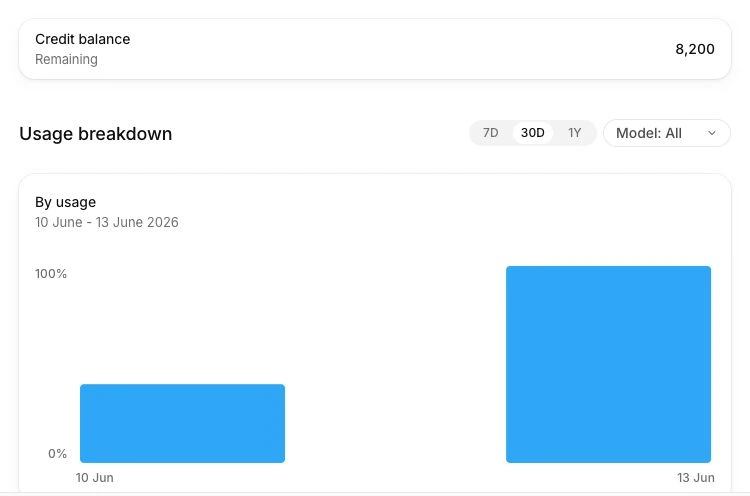
Feldar also keeps AI usage within its own credits and Usage view. The selected model and context affect usage. The benefit is the working arrangement: you can select from the available catalog and review your usage in Feldar.
The real tradeoff: built-in actions or a configurable AI workflow
Section titled “The real tradeoff: built-in actions or a configurable AI workflow”Novelcrafter’s custom prompts cover scene completion, scene summarization, text replacement, and workshop chat. If you want to build and reuse your own instructions for those jobs, that is a concrete reason to consider it. Novelcrafter prompt types.
Its Codex also offers explicit context rules, including always including an entry, including it when detected, and preventing it from being sent to AI. Writers who want to manage those rules closely may prefer that approach. Novelcrafter Codex tracking.
Feldar is the stronger recommendation when you want to spend the session making decisions about prose through its ready-made writing and review actions. Novelcrafter may be the better fit when controlling the prompt and connection setup is itself a requirement.
A practical test: revise a scene with a worldbuilding rule
Section titled “A practical test: revise a scene with a worldbuilding rule”Suppose your fantasy story has a rule: crossing the mountain pass costs a traveler one memory. Your scene must reveal that cost through a character’s behavior without explaining the whole magic system.
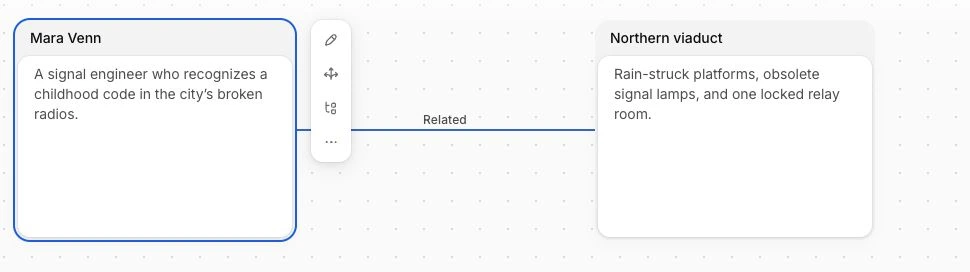
In Feldar, create a Note card for the rule, a Character card for the traveler, and a Location card for the pass. Record the relevant relationship and the facts the scene must preserve. With at least 100 words of manuscript context, open Outline and choose Generate scenes. Edit the scene description to capture the moment: the traveler recognizes her companion’s face but cannot remember his name.
Draft the page or paste your existing scene. Select an explanatory paragraph and try Dramatize. Compare the alternatives for whether they show the cost through action. Then ask the Editor Lens, “What does this passage make explicit too early?” You might keep one sentence from a candidate and rewrite the rest yourself.
Novelcrafter supports a comparable test through scene-beat instructions and context from existing prose and the Codex; its guide documents reviewing a generation before applying it. Both tools leave the writer with a judgment call. Novelcrafter prose generation guide.
The deciding question is which process helps you preserve that rule while improving the scene, with a level of setup you are comfortable maintaining.
Evaluate Feldar without moving your whole novel
Section titled “Evaluate Feldar without moving your whole novel”- Keep your Novelcrafter project as your existing reference while testing.
- Copy one representative scene into a Feldar page and check the formatting.
- Manually add only its essential characters, setting, and story rules to Canvas.
- Test a local Rewrite and a Lens question before attempting a larger draft.
- Compare the revised passage with your original and inspect Usage after the AI work.
Copying one scene is a practical fallback, not an automatic conversion of a Novelcrafter project or Codex. Recreate the small amount of context needed for the test, then decide whether a broader move is worthwhile.
Frequently asked questions
Section titled “Frequently asked questions”Does Novelcrafter already support story-aware AI?
Section titled “Does Novelcrafter already support story-aware AI?”Yes. Its Codex and prose-generation documentation describe using stored story information alongside existing prose. Feldar’s recommendation rests on its workflow and tools, not a claim that Novelcrafter lacks context. Novelcrafter Codex.
Do I need my own AI provider account for Feldar?
Section titled “Do I need my own AI provider account for Feldar?”Feldar’s documented AI workflow uses its available model catalog and credit balance. Novelcrafter’s help directs AI users to an external vendor connection or a local model. Check each product’s current account options before deciding. Novelcrafter AI help.
Which should I choose if I write most prose myself?
Section titled “Which should I choose if I write most prose myself?”Choose based on the planning and revision process you will actually use. Feldar lets you write manually and call on Rewrite, Checks, or Lens selectively. We recommend it when those focused passes are more useful to you than designing a custom generation workflow.
Choose Feldar for a connected AI writing session. Start writing and use the Quickstart with a single scene before committing a larger project.
Sources and related comparisons
Section titled “Sources and related comparisons”Competitor details were checked against Novelcrafter’s official Codex, Codex tracking, prose generation, prompt types, and AI help pages on October 30, 2026.
Also compare Feldar with Sudowrite, Scrivener, Campfire, and Plottr.